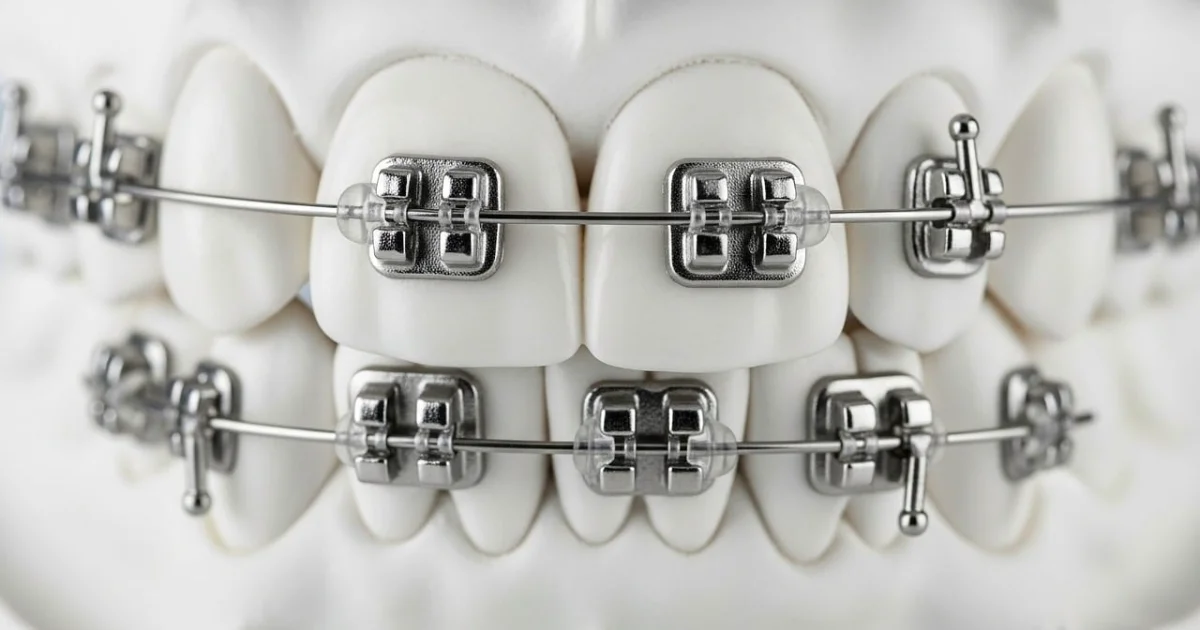
The main difference is this: fixed braces are brackets bonded to your teeth that only your orthodontist can remove, while clear aligners are removable trays that you take out and put back yourself. Both move teeth with gentle, controlled pressure. Which one suits you depends on your teeth, your bite and your daily habits, and that is decided by an orthodontist after an examination, not from an article or a photo.
The two approaches side by side
| Fixed braces | Clear aligners | |
|---|---|---|
| What they are | Brackets bonded to the teeth, joined by a wire | A series of removable, nearly transparent trays |
| Who can remove them | Your orthodontist only | You, every day |
| Wear time | Constant during treatment | For the number of hours your orthodontist sets |
| Eating | Some foods need care | Trays come out to eat and drink anything but water |
| Cleaning | Brushing around brackets and wire, sometimes with extra brushes | Brushing as usual, plus cleaning the trays |
| Checks | Visits for wire adjustments | A mix of remote checks and visits, as set in the plan |
Where braces are often chosen
Fixed braces are often considered for more complex tooth movements, because the orthodontist controls the appliance directly and does not rely on how many hours you wear it. Some movements are more predictable this way.
Where aligners are often chosen
Clear aligners suit many, but not all, cases. They are popular with adults who want a less visible appliance and the option to remove it for meals and cleaning. They only work if worn for the hours advised, so they ask more self-discipline from you.
Questions that help you decide
- How complex is my case, and which method is more predictable for it?
- Can I realistically wear trays for the hours required each day?
- Does my work or lifestyle make one option easier to manage?
- How will I clean my teeth and the appliance every day?
Possible risks with both
- Teeth often feel tender for a few days after an adjustment or a new tray.
- Poor cleaning can lead to gum inflammation or white marks on the teeth.
- Teeth can move back if retainers are not worn as advised, whichever method was used.
- In a small number of patients, tooth roots shorten during treatment. This is monitored.
Active tooth decay or untreated gum disease is treated first. Cases that need jaw surgery alongside orthodontics are different again.
If you live outside Turkey
Ask how and where checks will take place. Some can often be done remotely, others need a visit, and this differs between the two methods. Ask for a written visit plan and for the records your own dentist at home will receive, and keep your own dentist informed.
Questions to ask any orthodontist
- Are aligners, braces or another method suitable for my case, and why?
- How long is treatment expected to take, and how many checks are needed?
- Which checks can be done remotely, and which need a visit?
- What happens if a tooth does not move as planned?
- What will I wear afterwards to keep the result, and for how long?
- Who looks after me if I have a problem at home?
Where we fit in
LetsDentalSmile is a licensed dental practice in Istanbul. Read more on our orthodontics page. A remote pre-assessment is not a diagnosis; a plan is confirmed only after an examination.